This is the multi-page printable view of this section. Click here to print.
Friendship
1 - HL5BTF and VK4BTF: CQ, A Bond of Half a Century
Written by HL5KY
(AI translation)
Bernie’s Early Years
Bernie was born in 1929 in Haarlem, a city in the west of North Holland. Once a thriving center of trade, Haarlem had long yielded its former glory to Amsterdam, remaining a quiet hinterland that held only the faded traces of its past.
To make matters worse, the dark clouds of the Great Depression, triggered in the United States the year he was born, crossed the Atlantic and cast a heavy shadow over the Netherlands. Poverty seeped into every corner of the city, and Bernie’s family could not escape its somber reach.
In 1939, before the long shadow of the Depression had even begun to lift, Nazi Germany’s invasion of Poland ignited the flames of the Second World War. On May 10, 1940, as Bernie turned eleven, German boots trampled the Dutch border to secure a passage toward France. The peaceful homeland he had known was instantly swept into the violent vortex of war.
Within eight days of the invasion, the Netherlands raised the white flag, falling under the rule of Nazi Germany. The world grew darker still, and increasingly ruthless exploitation stripped people of their ordinary daily lives and livelihoods. Through the eyes of a young boy, the world was filled with perpetual hunger and anxiety.
Five harrowing years passed in quiet endurance through terror and starvation. The dark era, which had seemed endless, finally drew to a close. On May 8, 1945, Germany bowed before the Allied counteroffensive, and the bells of peace at last rang out.
Just four days after the artillery fell silent, sixteen-year-old Bernie boarded a ship bound for Sweden, carrying nothing more than a worn leather bag.
For a young stranger in a foreign land with neither connections nor possessions, only the lowest and harshest positions were open. Bernie took his first steps into the working world as a dockworker for an international shipping company—labor that even locals avoided.
Life aboard the cargo ships navigating rough seas was unforgiving. Enduring shouts and rebukes over clumsy work was a daily routine, and when towering waves crashed over the deck or reefs loomed ahead, he walked the fine line between life and death.
On sea routes where grown men often gave up and left, many crewmates came and went, but Bernie held his post in silence. Perhaps noticed for his steadfast diligence, his long hours of labor were eventually recognized, and he was reassigned from a dock loader to a pipefitter’s assistant in the ship’s engine room.
Filled with the smell of heavy oil and the dull roar of engines, the engine room was better than raw manual labor, but by no means easy. For a sixteen-year-old who had never learned mechanical theory or properly read a piping diagram, everything was an unfamiliar and intimidating challenge.
Yet rather than shrinking back, he leaned into his natural curiosity and listened carefully to the breathing of the machines. Driven by the single conviction that “a skill mastered by one’s own hands never betrays,” he navigated between hot steam pipes day after day.
Time went by, and as calluses hardened on the young man’s rough hands, his mechanical skill, his experience, and his wages steadily grew.
Meeting Yuni Kim
Time moved diligently forward, and in 1949, his fourth year with the company, twenty-year-old Bernie finally boarded an ocean-going merchant vessel crossing the high seas. The ship frequently cast anchor in Hakodate, a historic port city at the southern tip of Hokkaido, Japan.
The trading port, steeped in an exotic atmosphere, had an alleyway that offered solace to foreign sailors weary from long voyages across the sea. Clustered along the street were small restaurants serving Western and Northern European flavors.
Yearning for the tastes of home, Bernie frequently visited a small eatery in that alley, where he met Yuni Kim, a young Korean woman working there.
The brief greetings exchanged amidst the hustle and bustle of an unfamiliar port soon turned into long conversations, and the two young souls from different worlds naturally grew close.
Though their backgrounds and native tongues were entirely different, they shared a deep understanding that required few words. The painful wounds of a lost homeland and the loneliness of having to build a life far from family in a distant foreign land were burdens of life only they could truly understand and comfort in one another.
Because of the sailing schedules dictated by the rough seas, the days spent longing from afar far outnumbered the days spent together in Hakodate, but physical distance was never an obstacle for their hearts. The time spent apart only deepened their affection.
Yet their brilliant, fleeting season did not linger long. Before their burgeoning love could fully blossom, Bernie’s ship received an unexpected order for an abrupt change of route.
Yuni Kim, pushed by the harsh realities of livelihood, also had to leave Hakodate in search of better means. Like an ebb tide carrying them into an uncertain parting, the bond left in the misty port came to a bittersweet pause.
Emigration to Australia
Left alone once more, Bernie quietly carried on with his life as a seafarer, but the emptiness lingering in a corner of his heart and a longing for a new beginning drew him toward another horizon.
Looking to the Southern Hemisphere in search of a land of opportunity, he took his first steps on Australian soil in 1956. Armed with the mechanical skill and perseverance forged at sea, he began a new chapter in the unfamiliar continent as a boilermaker.
In an Australia of vast, endless lands and sparse populations, radio communication was an indispensable tool of daily life. Bernie took hold of a transceiver for work efficiency on the field, and his characteristic curiosity soon drew him into the unseen realm of radio waves.
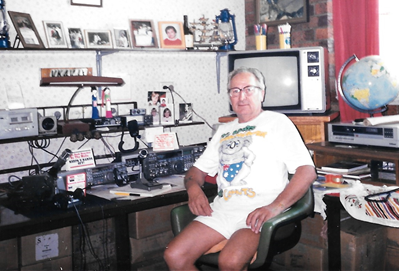
[ VK4VJY’s Shack ]
Though the radio began merely as a work tool, he became deeply enchanted by the magic of signals bridging empty space. In 1986, he finally established an official amateur radio station under the callsign VK4VJY.
Yuni Kim in Korea
Around the same time across the sea in South Korea, a young college student named Yuni Kim was likewise falling deeply under the spell of radio waves.
During her early days as a freshman, she visited an upperclassman to borrow study materials, which happened to lead her into the university’s amateur radio club room. The moment she witnessed this magical world communicating through crackling static with unseen corners of the earth, she was completely captivated.
Gradually drawn into the profound resonance of amateur radio through club activities, Yuni earned her amateur radio operator’s license in the autumn of 1985. Taking the microphone at HL0M, the club station of Pusan National University, she set sail on the vast ocean of radio waves.
Amateur radio being a technically demanding hobby, female operators (YL, Young Lady) were remarkably rare compared to men. Whenever her clear, high-toned voice appeared on frequencies dominated by low male voices and harsh mechanical tones, a rare scene unfolded as operators spinning their dials rushed in to call her frequency.
Whenever she had free time between lectures, her footsteps inevitably turned toward the club room, and on weekends without other plans, she would sit faithfully before the transceiver.
One weekend, while immersed in operating alone in the empty club room, the radio suddenly went dead and the contact was cut off. Being a newcomer with no technical knowledge, she had no choice but to head home with a heavy, disappointed heart.
The following day, after watching the senior members easily replace a blown fuse, she began carrying spare fuses in a corner of her bag. From that day on, whenever the radio went silent, she would replace the fuse herself and carry on with her contacts.
The First Contact
Time passed, and on a spring day in 1986, Yuni Kim was calling CQ on the 21 MHz band as usual.
Yuni Kim: “CQ CQ CQ This is HL0M, Hotel Lima Zero Mike. HL0M calling CQ and standing by.”
In the Southern Hemisphere, Bernie was tuning across the bands in Australia when he heard Yuni’s CQ.
‘A Korean station. And a YL operator at that…’
Bernie quickly prepared to transmit and made the call.
Bernie: “HL0M, HL0M. This is VK4VJY, Victor Kilo Four Victor Juliet Yankee, over.”
Yuni Kim: “Ok, VK4VJY this is HL0M. Thank you very much for the call. Your signal is five and seven. 57. Very nice signal into Korea. My QTH is Pusan, Papa Uniform Sierra Alfa November. Pusan, Korea is my QTH. Name here is Yuni, Yankee Uniform November India, Yuni is my name. Back to you. VK4VJY this is HL0M.”
(VK4VJY, this is HL0M. Your signal is 57. My location is Pusan, Korea. My name is Yuni. Back to you. Over.)
Hearing the operator’s name over the receiver, Bernie was taken aback.
‘Yuni… The very same name as my first love.’
Holding back a surge of emotion, he asked in a trembling voice:
Bernie: “Very good, Yuni. What is your full name?”
Yuni Kim: “My full name is Yuni Kim. Kilo India Mike. Yuni Kim.”
Bernie: “Oh my goodness. Yuni, Yuni Kim. What a surprise! I can’t believe it.”
‘Yuni Kim… She even shares the same full name. How can this be?’
Bernie was speechless for a while. Not knowing how common the surname ‘Kim’ was in Korea, his astonishment was only multiplied.
‘Her voice is far too young to be her. Could she be related? Did she inherit her mother’s name…?’
Their conversation unfolded in a whirlwind of joy, wonder, and a longing preserved across decades. Though the young college student was not his past love from Hakodate, to Bernie, she felt like a miraculous reconnection granted by fate.
This first encounter soon grew into regular scheduled contacts. Bernie taught her the Dutch word “Opa,” meaning grandfather, and warmly asked her to call him Opa.
The propagation conditions were favorable, and because both stations were equipped with high-performance beam antennas, their contacts were consistently clear. The warm conversations they shared on 21.155 MHz became well-known over the Pacific.
From Japan to Southeast Asia, Australia, and New Zealand, numerous amateur radio operators and Shortwave Listeners (SWLs) tuned their receivers to their frequency at the scheduled hours, sometimes sending in thoughtful reception reports.
At the time, the official English spelling for Busan was Pusan.
SWL stands for Short Wave Listener, referring to someone who listens to radio transmissions, particularly amateur radio communications. SWL activity allowed individuals to naturally acquire radio knowledge and operating skills, making it an essential stepping stone before becoming a licensed Ham. Typically lasting from a few months to several years, some chose to remain SWLs for a lifetime.
Their bond soon expanded beyond the radio waves into the physical world. Letters and gifts carrying their sentiments crossed the ocean. Yuni sent traditional Korean dolls and folk crafts, while Bernie sent back souvenirs crafted by Australian Indigenous artisans.
Because of his poor handwriting, Bernie often recorded his voice onto cassette tapes instead of writing letters; over two hundred of these audio tapes were delivered to Yuni over the years.
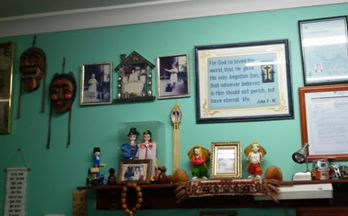
[ Bernie’s room decorated with Korean dolls ]
The Gift of a Radio
As their cross-border, cross-generational friendship deepened over the course of a year, Yuni approached her final year before university graduation. Once employed, she would no longer be able to sit freely in front of the club station (HL0M) transceiver. Under the conditions of the time, establishing a personal radio station from scratch was a daunting task, both technically and financially.
Faced with the regret of a looming pause and the unavoidable reality of graduation, Yuni gently explained her circumstances to Bernie. She promised that while their contacts over the air might become less frequent, she would continue to send her voice and news through letters and cassette tapes.
To Bernie, however, the scheduled contacts with Yuni had become one of the most cherished and eagerly anticipated parts of his daily life. The thought that they might no longer meet over the air brought him deep sorrow.
After long deliberation, Bernie made a significant decision: he would purchase a complete radio setup and a directional beam antenna and ship them to Korea so that Yuni could set up a station in her own home.
The equipment he carefully packed was the Kenwood TS-520 transceiver full line, an iconic dream rig among amateur radio operators of that era. It was a complete lineup that included not only the main transceiver but also an antenna tuner, external speaker, external VFO, digital frequency display, and a multi-band beam antenna to be mounted on the roof. At the time, these were rare and expensive pieces of equipment in Korea.
Another Australian radio friend, VK5YM, who had warmly followed their story over the airwaves, was moved by this thoughtful project and sent an antenna thrust bearing to support smooth rotation of the heavy antenna, adding his own warm encouragement.
On the day the large parcels arrived in Busan after crossing the Pacific, Yuni rushed alone to the international post office in Gwangalli, carefully loading the heavy boxes into a taxi. A few days later, she had to travel to the Yongdang Customs warehouse to retrieve the massive antenna components. It was an overwhelming load for a young female student, but an even greater obstacle was the heavy customs duty notice handed to her by the officer.
“This is a pure gift sent by a grandfather in Australia so that a poor student can pursue her hobby… How could there be such a heavy tax on this?”
Tearfully sharing the tender story behind her bond with Bernie, she touched the hearts of the customs officers, who graciously granted duty-free clearance for the equipment.
Though she managed to bring the equipment home after many twists and turns, assembling and raising a large beam antenna on the roof was another formidable hurdle for someone unfamiliar with the technical mechanics. Fortunately, senior operators in the Busan area—including HL5BCW, HL5BEF, HL5BUC, and others—stepped forward without hesitation.
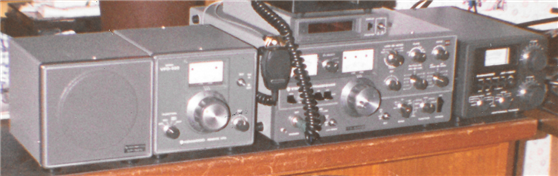
[ TS-520 set ]
Thanks to the hard work of these senior Hams, the silver beam antenna rose proudly above the roof, and the equipment was systematically installed. Soon, along with the station license, she was assigned her own unique callsign: HL5BTF.
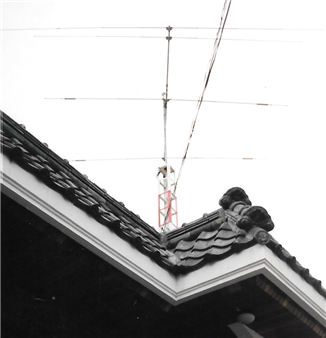
[ A beam antenna ]
From that day forward, Yuni could comfortably continue her scheduled contacts with Bernie from her own room, enjoying a richer Ham life navigating the wider ocean of radio waves to connect with the world.
While awaiting her teaching appointment after graduation, an unexpected administrative delay prolonged her wait, but this turned into a period of valuable opportunities.
During the 1988 Seoul Olympics, she served as a radio communications coordinator and VIP interpreter at the Busan Yachting Center, building unforgettable memories. Later, invited by Japanese radio friends with whom she had formed close ties over the air, she spent a month on a homestay journey across Japan—an experience unique to an amateur radio operator.
Through the recommendation of the late HL5MK, she also had the opportunity to take her first professional steps at the Japanese Consulate-General in Busan. As her world expanded day by day, Yuni began to harbor a new dream. She resolved to study abroad in Australia, where her dear ‘Opa’ Bernie lived, and quietly began preparing for the journey.
Marriage to Yuni Kim
Around the time she was preparing to study in Australia, Yuni crossed paths with me (HL5KY), a university alumnus, over the airwaves as if guided by fate. Though we had walked the same campus, we had never known each other until the invisible bridge of radio brought us together.
The occasion was purely accidental. She was conducting a weekly scheduled contact with her club station (HL0M) peers, and I happened to be visiting the home of one of those peers, HL5BCT, where I was handed the microphone.
Sometime later, Marty (AL7JF), an American amateur radio operator from Alaska who had frequently contacted Yuni, visited Korea to meet her. In arranging hospitality for the visiting operator, I volunteered to serve as driver and guide. Along the road of escorting a friend from the airwaves in real life, the distance between Yuni and me narrowed naturally.
Our mutual trust and affection deepened with time, and on a warm spring day in 1990, we were married amidst the blessings of numerous radio friends and mentors.
Around that time, Yuni also began her long-awaited career as a teacher. Though the days were busy balancing unfamiliar school responsibilities with managing a new household, she never missed her scheduled contacts with Bernie across the ocean.
Meanwhile, Bernie in Australia was navigating a dark valley in his life. After prolonged domestic strife, he had parted ways with his family and was left entirely alone.
Having been separated from his family during the devastation of World War II as a child and wandering the rough seas before finally building a home, finding himself alone once more brought him unspeakable sorrow.
There were days when the emotional pain kept him from sitting in front of his radio, but he never let go of his link with Yuni. To a man left alone in a harsh world, Yuni was more than a radio friend; she was his only true family and a sanctuary of heart that offered a warmth deeper than blood ties.
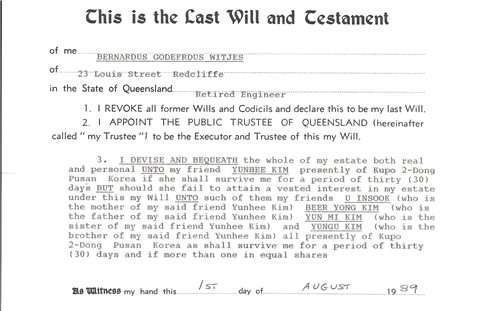
[ The will ]
Though he possessed modest means, Bernie resolved to leave everything he had in the world to Yuni Kim and had a formal notarized will drawn up through an attorney.
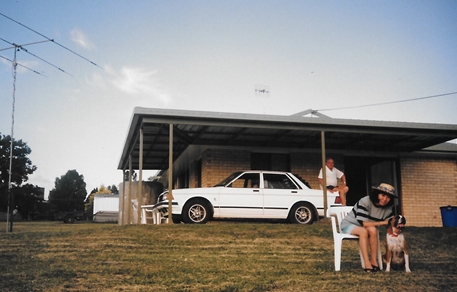
[ Yuni, visiting Bernie’s home ]
When we later visited Australia, he placed eight luminous rough opals, which he had treasured for years, into her hands, offering a deep affection and sincerity surpassing that of a biological parent.
Bernie’s Visit to Korea
As time passed, our lives settled into stability, and our contacts with Bernie over the airwaves continued faithfully. Then, in the late autumn of 1994, Bernie sent unexpected news that he wished to visit Korea.
Both my wife and I were tied to our jobs, and we lived in a modest two-room apartment. We asked if he could adjust his visit to match Yuni’s school vacation, but he insisted that he had to come immediately and promptly boarded a flight to Korea.
On the third night after his arrival in Korea, Bernie revealed the true reason behind his hurried journey across the sea. He had been undergoing examinations at major hospitals for prostate trouble, and doctors had informed him that prostate cancer was strongly suspected.
Had it been a simple condition, one might hold out hope for treatment, but if it were cancer, medical science at the time considered it virtually a terminal sentence.
Before departing this life, he wished to see the face of Yuni—who was like a daughter to him—one last time, even if it meant straining his health. To ensure that he would not become a burden to us should anything happen during his stay, he had arranged travel insurance covering all posthumous procedures beforehand, handing us the policy document with trembling hands.
In Australia at the time, a diagnosis of prostate cancer was widely regarded as giving a patient no more than six months—a particularly feared condition among Western men—and his confession weighed heavily on our hearts.
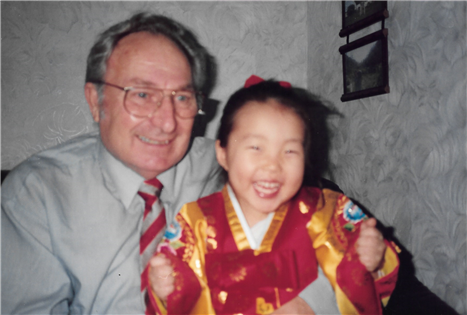
[ Bernie and Yuni’s daughter ]
During his nearly two-month stay, Bernie gradually settled into the rhythms of everyday life in a foreign country. After we left for work, he would walk alone around the apartment grounds and nearby alleys, sharing friendly gestures with neighborhood elders despite the language barrier, and helping with light chores around the house.
On the surface, the days were peaceful and gentle, but relentlessly, his gait began to deteriorate day by day.
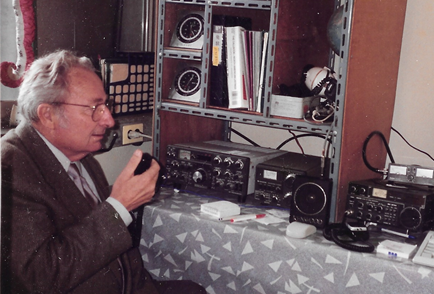
[ HL0M, where the whole story beban ]
The Miracle of Bee Pollen
Around that time, my father expressed a wish to host a meal for Bernie, saying he was a precious elder who had been like a parent to Yuni. A family gathering was arranged. As warm conversation flowed, talk naturally turned to Bernie’s health.
Hearing of his struggles with prostate issues, my father—drawing on years of experience working in health foods—strongly recommended bee pollen, stating that nothing supported prostate health quite like it.
Westerners often held an appreciation for the efficacy of Eastern remedies, and to Bernie, this suggestion felt like a ray of hope; he agreed to try it immediately.
We had some bee pollen at home, and he began taking it that very day. About a week later, early in the morning, we were awakened by an urgent knock on the bedroom door.
Opening the door, we found Bernie standing with a flushed face. Having suffered from severe difficulty in urination, he explained with considerable excitement that he had just passed urine smoothly and continuously.
While it was wonderful news, a quiet worry crossed my mind that it might simply be a temporary placebo effect born of psychological relief. Fortunately, the improvement went far beyond expectations.
With each passing day, his walking improved noticeably and his condition normalized. By the time he was set to return to Australia two months later, he had recovered nearly all of his regular vitality. Before his departure, we carefully prepared two large jars of bee pollen for him to take home.
When he underwent a medical checkup upon returning to Australia, the doctors were astonished by his condition and asked what had happened in Korea. When Bernie shared the story of the pollen brought from Korea, staff and patients at the hospital were intrigued, creating quite a stir as people sought to obtain the same pollen.
After he finished the two jars, we wished to send more, but Australia’s strict quarantine regulations on plant and animal products made it impossible to send via standard parcel post, and difficult to carry in person. At the time, Asiana Airlines operated flights to Cairns, where quarantine procedures were relatively manageable, suggesting an entry route.
Hearing that fellow radio operator HL5UMO was planning a trip to Australia, we asked him to enter through Cairns and deliver the pollen to Bernie.
From Cairns to southern Queensland, where Bernie lived, was an overland distance of some 1,500 kilometers, yet our friend willingly took on the long bus journey to deliver it.
As we discovered later, the remarkable pollen was actually not produced in Korea, but had been imported from New Zealand. Regardless, from that time on, Bernie regained his health completely, to the point where regular hospital visits were no longer necessary.
The Gift of a Linear Amplifier
As the mid-1990s approached, solar sunspot activity gradually declined, and radio propagation conditions noticeably deteriorated. Furthermore, our urban living environment suffered from high HF noise levels, frequently burying Bernie’s signal in heavy static.
Holding a Novice license at the time, Bernie was limited in output power and could not operate on the 14 MHz band—the “Golden Band” favored for stable, long-distance communication.
Golden Band: Among the HF bands, 14 MHz (20 meters) is known as the Golden Band because long-distance propagation remains reliable even during periods of low sunspot numbers. It is generally restricted to higher-class licensees. Due to its reliability for DX contacts, many operators choose to work exclusively on 14 MHz throughout their lives.
To raise his power output and operate freely across frequencies without restrictions, he needed to upgrade his license. At the time, the Australian amateur radio examination was not based on a static question pool, making it a demanding challenge for Bernie at an advanced age.
Driven solely by the desire to hear Yuni’s voice more clearly, he set about learning Morse code (CW) and studying complex radio engineering theory late in life. Through persistent effort, he successfully earned Australia’s top-tier qualification, the “Unrestricted license,” in 1995.
His passion did not stop there. Wanting to share the same suffix (“BTF”) as Yuni’s callsign (HL5BTF), he personally visited the operator who already held the callsign multiple times, explaining his story and requesting a transfer.
After complex administrative procedures and a long wait, he was finally issued the callsign VK4BTF. It was the moment their callsigns were joined across the ocean under the shared name of “BTF.”
Just as Bernie had enabled Yuni to establish her home station by sending a radio and antenna in her youth, it was now our turn to celebrate his hard-won achievement and repay his long-standing kindness. We decided to gift him a high-power linear amplifier.
Because the amplifier was exceptionally heavy, a custom wooden crate had to be built, and the international shipping costs were substantial, but we were determined to convey our gratitude and congratulations.
Upon receiving the heavy amplifier, Bernie was as joyful as a young child. His signal crossing the Pacific cut through the surrounding noise floor, arriving stronger and more stable than ever before.
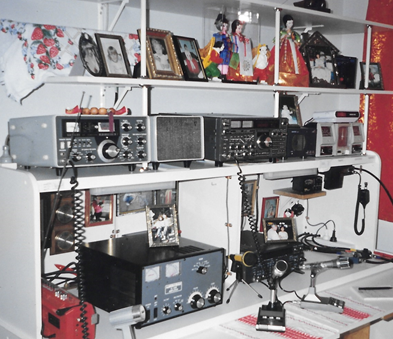
[ A Linear Amplifier at the Bernie’s Shack ]
VK4BTF SK
Thereafter, our friendship carried over the airwaves deepened through the changing seasons. Restored to health, Bernie met a new companion, built a warm home once again, and his active amateur radio life alongside his dramatic life story spanning World War II was featured in several local newspapers.
As the years moved into the 2010s, age-related hearing decline and deteriorating radio propagation made analog shortwave contacts less frequent. However, with the advent of the digital era and the development of the internet, digital communications, and email, we adapted our ways of keeping in touch, steadily exchanging news and photographs to share each other’s warmth.
Yet before the passage of time, no signal, however strong, could remain forever. In 2020, Bernie, who had always called us warmly from across the Pacific, entered the eternal silence (Silent Key). No matter how far we turn the frequency dial today, that gentle voice over the receiver can no longer be reached.
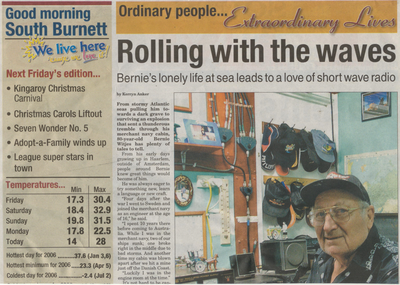
[ Bernie’s story published in local newspapers ]
Through the wondrous world of amateur radio, I have encountered countless souls, but the bond with Bernie that bloomed across the open skies was the most luminous and extraordinary miracle of our lives. Though his signal has fallen silent, all the moments of contact that pierced through static to touch our hearts will resonate forever within us, like an unattenuated wave echoing through time.
SK: An abbreviation for Silent Key, referring to a deceased radio amateur. In another context, transmitting the letters ‘S’ and ‘K’ joined together at the conclusion of a CW contact signifies the formal end of communication.
Friends
While amateur radio is often regarded merely as a technical hobby dealing with circuits and electronics, for Yuni Kim, it was a warm window of communication connecting her heart to an unknown world.
She valued the interpersonal connections of human encounters far more than mechanical curiosity, and thanks to the radio waves traversing the open air, she formed deep bonds with numerous friends worldwide, crossing national borders.
Michael (DL9LBD) in Germany, who was a seventeen-year-old boy when they first met on the air, shared his youth and transition into adulthood with her through countless handwritten letters as well as regular radio schedules. Even after each had established their own families, they continued to stay in touch, and in 2012, Yuni visited Germany to meet him face-to-face for the first time in over twenty years. The youthful boy had grown into a dependable father of an upper-elementary school daughter.
Keiko (JJ3GNR) in Japan was like a warm elder sister. Both sharing an interest in languages, they taught and learned each other’s language during their contacts, building a unique closeness. Years later, they now exchange news through letters and phone calls rather than over the air, occasionally crossing the sea to visit each other’s homes and sustaining a sisterly friendship.
Beneath the global skies, there were many other friends who welcomed her with open arms whenever she visited. From DJ6EA, ZL1SN, and VK3AZN, who were always ready with a warm greeting, to ZS2ABC in South Africa, who took the microphone cheerfully calling Yuni his “Korean girlfriend”; ZL1AIF in New Zealand, who lived in a picturesque home beneath a hill showered in starlight; WA6FPK, a Japanese-American who enjoyed singing Korean folk songs; the VK2AHJ couple in Australia, who embraced her like biological parents; and VK2CCK, who fell in love with Korea and married a Korean—countless individuals enriched her life.
During her professional training in the United States, KB6TJX met her alongside her Korean colleagues, treating them to a fine meal and earning the admiration of her peers with his gentlemanly demeanor.
As time has passed, some cherished names have entered eternal silence (Silent Key)—such as VK5YM, N6POP, VK4ADZ, and ZL2AOH—yet the warmth they left behind remains, and we still exchange friendly regards with their families today. These beautiful encounters, forged by invisible radio waves, remain timeless jewels shining brightly across Yuni’s life.
Epilogue by the Author (HL5KY)
If someone were to ask me, “What does amateur radio mean to you?” I would answer without hesitation:
“People, and the bonds between them.”
A pursuit where one may seem to turn the dial alone in solitude, yet is never truly alone. A hobby that becomes complete only when someone on the other side of the wave responds; one where we handle cold metal transceivers, only to encounter the warmest of human hearts. This is the true nature of amateur radio that I have loved all my life.
Every meeting that begins with a single ‘CQ’ cast into the open sky is a precious bond akin to a miracle. Today, dreaming of someone’s Bernie and someone’s Yuni Kim, I hold the PTT switch with an expectant heart.